
Rings of Growth
How Mining Can Drive Energy and Jobs


Written by Meron Tesfaye, Gyude Moore, and Todd Moss, originally published on November 6, 2025, on The Energy for Growth Hub website.
Governments and companies are scouring Africa to secure minerals and metals. They care about their own national security and supply chain diversity. New deals must, of course, also benefit Africa. But here’s the catch: many resource-rich African countries are still stuck as extraction cash cows. They risk gaining little from all this attention. So how will it be different this time? How can Africans turn this surge of interest into broader, lasting benefits? The short answer: energy.
Here are three Rings of Growth that show how mining can drive long-lasting energy and jobs.
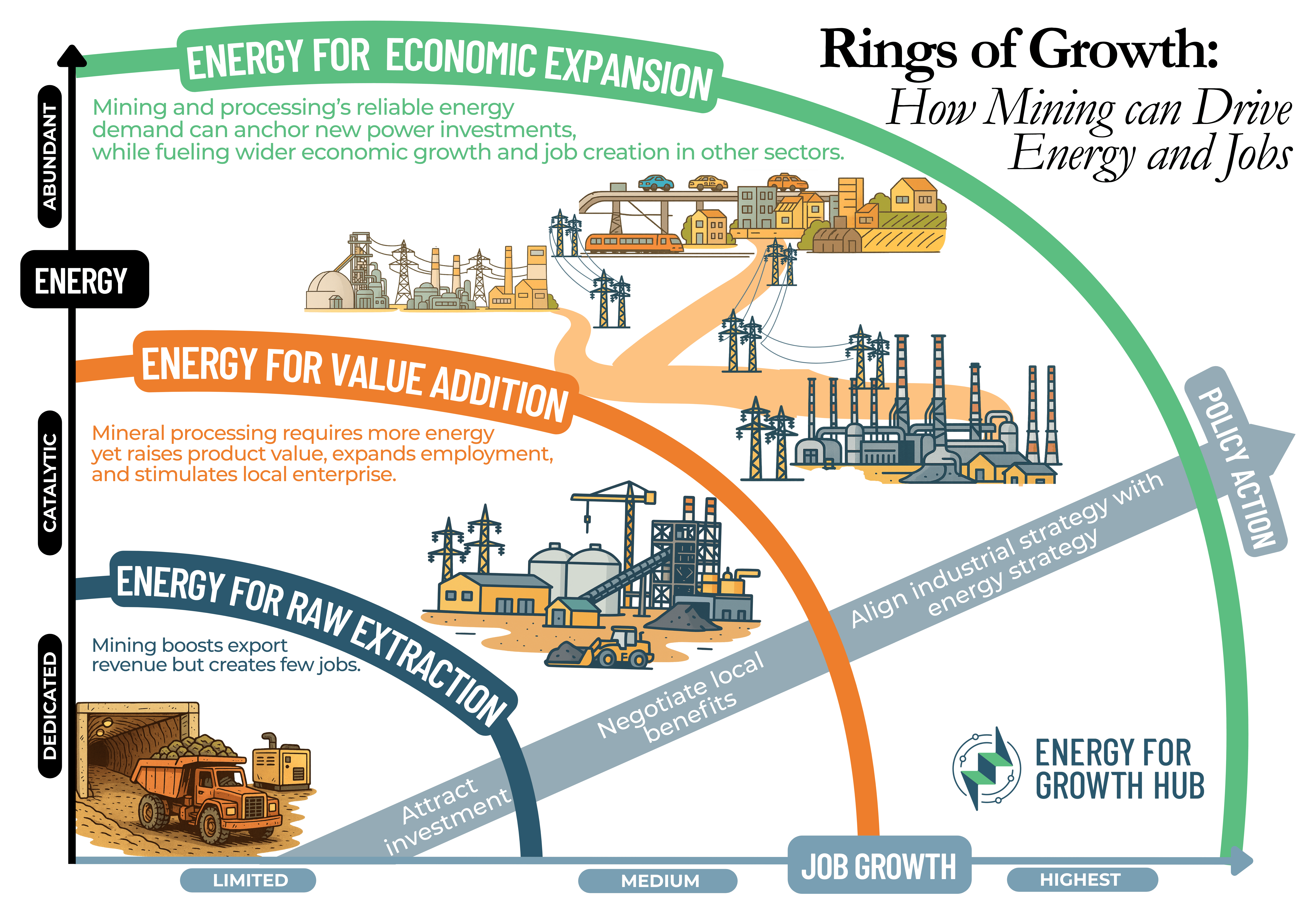
The first ring is the familiar status quo: Energy for Raw Extraction.
Mining operations are energy-intensive, requiring continuous, reliable, and affordable power. More mining will mean more energy. But in countries like South Africa, Zambia, and Ghana, unreliable and costly power is forcing mines to either shut down or turn to their own private power. Incoming investors, focused on protecting their bottomline, are likely to double-down on standalone power sources that guarantee predictable operations. The result? Higher costs of doing business, fewer jobs, weaker utility revenues, and little local spillover benefit beyond the mine fence.
Africans are asking for the second ring: Energy for Value Addition.
Indignant at the old extraction model, more than 20 African countries have reacted with raw material export bans—with some, like the DRC, even going as far as suspending some mineral exports. Behind these tough policies lies a growing determination to keep more economic value at home. But, moving up to mineral processing and higher-value manufacturing requires even more reliable energy. When done right, the effects can be catalytic: greater market value, better-paying jobs and growth of local enterprises. To capture these gains, governments need to negotiate hard for greater local benefits. Yet without integration into a broader energy strategy, even value-addition efforts can fall short of their promise. Some countries are already facing this reality, forced to lift their export bans after power shortages made local processing impossible.
The third ring should be the real goal: Energy for Economic Expansion.
Mining and processing are large, long-term energy offtakers, so they can be even more valuable as anchors for bankable investments in new energy generation, transmission, and distribution. That same infrastructure can support a far wider range of sectors and communities, driving economic activity and job growth across manufacturing, services, and agriculture. To make this more ambitious approach work, however, requires governments to align industrial strategies with energy planning.
 | A guest post by
|
 | A guest post by
|
 | A guest post by
|